VE Academy · Worked case study
The classroom projector: a complete value study
One real kind of product, taken apart and through all six phases of a value study. You'll see every part, what it does and roughly what it costs, then watch the method find where the value is. It brings together everything in the course, from function analysis to the business case.
The VH-3600 is a made-up model, built on the usual design of a 3LCD classroom projector. Costs are taken from a detailed should-cost report for a comparable 3,600-lumen XGA 3LCD projector, with the sources at the end of section B.
Also see case study 2, the windscreen wiper.
A · Meet the product
Take it apart in 3D
Turn the projector round, explode it to see all 49 kinds of parts, or follow the light from the lamp to the screen. Click any part for its name, its job and its estimated cost. The numbers match the bill of materials below.
Read the transcript
This is a complete value study of one product, a classroom projector, from the first facts to the final decision.
It's a three LCD projector: three thousand six hundred lumens, from a lamp that runs at two hundred and ten watts.
Take it apart and there are fifty kinds of part inside. Each one has a job, and each one has a cost.
Light leaves the lamp, is split into red, green and blue, and passes through three small LCD panels. A glass cube puts it back together, and the lens throws it on the wall.
It sells for four hundred and twenty-five pounds. Making it, and landing it in the UK, costs a hundred and forty-two pounds seventy.
The challenge is to take at least ten per cent out of that cost, without losing any brightness, picture quality, reliability or safety.
To do it, we'll follow the six-step value engineering job plan. Let's start with the facts.
Drag to turn · scroll or pinch to zoom · click a part
This browser can't show the 3D model. The parts list beside it and the bill of materials below have everything in it.
B · Bill of materials
Every part, what it does and what it costs
The bill of materials is where every value study starts: you can't judge value until you know what's there and what it costs. The costs come from a detailed should-cost report for a comparable projector. Each report line is shown at the report's cost, with the parts it pays for underneath, and each part has its main function as a verb and a noun.
Where the cost sits
The ten most expensive lines, largest first. Panels, lamp, lens and the video chips carry half the parts cost, so that's where a study looks first.
From parts to a landed projector
Where the £425 goes
Where the costs come from
- A should-cost report for a comparable 3,600-lumen XGA 3LCD projector: 200,000 a year, built by a tier-1 contract manufacturer in Shenzhen, costed in pounds.
- Every report line is kept at its cost. Where one line covers several parts, such as the integrator optics, VAVEhub splits it between them; the split always adds back up to the report's figure.
- Five small parts the report doesn't list (thermistors, interlock switch, front bezel, rear feet, manual pack) are added and marked. Together they come to £1.20.
- Panels are at a transfer price. Where a maker builds its own panels, the report prices them as if bought at arm's length, including the fab's running costs.
| Line / item | Description | Function | Qty | Unit cost | Cost |
|---|
Sources
The cross-checks are independent volume prices that sit close to the report's figures.
1Phase 1 · Information
Get the facts before the ideas
A study starts with facts, not ideas. The team agrees the brief, gathers the costs, the factory data and the volumes, checks them, and finds out what customers really value. Skip this and the workshop ends up arguing about opinions.
Read the transcript
Step one is information. Before anyone has an idea, the team gets the facts.
First, where the cost sits. The optical engine is fifty-five pounds twenty, more than half of the parts. The three LCD panels alone cost twenty-four pounds sixty.
The parts come to a hundred and five pounds twenty. Making it adds twenty-seven sixty, and freight, compliance and warranty another nine ninety.
Then the factory. Forty-two people and eighty-five minutes of work a projector. More than half that time is a forty-five minute burn-in.
Then check the data. The report was good, but five things didn't add up, including a hundred and sixty-five thousand pounds of tooling that nobody had itemised.
And ask the customer. Schools must have a bright picture in a lit room, and HDMI. Most don't care about the extra VGA ports, or the cable in the box.
One surprise. Over five years, a school spends more on electricity than on the projector itself.
With the brief signed and the facts checked, the team moves on to step two.
- BeforePrepare
- 1Information
- 2Function analysis
- 3Creative
- 4Evaluation
- 5Development
- 6Presentation
- AfterImplement and track
Before the workshop
- Pick the project. The VH-3600 is the highest-volume model and its cost is under pressure from cheaper rivals.
- Name a sponsor and a team: the product director as sponsor; optics, electronics and mechanical engineers, purchasing, the factory, quality, service, product marketing and finance, with a facilitator.
- Set the scope: the whole projector, its packaging and the factory process, up to delivery in the UK. The brand owner's own overheads and the sales channel are out of scope.
- Ask for data in advance: a should-cost report with a teardown, the factory audit, tooling, volumes, warranty data and customer interviews.
The brief
- Product
- VH-3600 classroom projector, 200,000 a year, made by a contract manufacturer in Shenzhen
- Goal
- Take at least 10% (£14.27) off the landed cost of £142.70, with no loss of brightness (3,600 lumens white and colour), picture, reliability or safety, at the same £425 price
- And
- Lower what it costs a school to own one
- Decision
- The sponsor decides in week 6
The facts gathered
- Where the cost sits (section B): the optical engine is £55.20, 53% of the parts. Electronics £30.10, case and cooling £12.80, packing and accessories £5.90. Making it adds £27.60 and getting it to the UK £9.90.
- The market: £425 in the shops (£354.17 ex VAT). After the £141.50 landed cost, the brand owner and the shops share about 60% of the ex-VAT price.
- The factory: 42 people and 85 minutes of work a projector, most of it waiting in burn-in. The panel alignment rig is the most expensive step.
- The customer: interviews with IT managers and teachers, sorted with the Kano model below.
Checking the data
Even a good report needs checking before a team builds on it. Every total in it adds up, and every wave and saving in the roll-up matches its ideas. Five things didn't, and the team noted them before going on:
- Tooling: the report amortises £880k, but the tools it lists come to £715k. The other £165k (perhaps fixtures and alignment rigs) isn't itemised.
- The factory margin is described as 8% of £122.20, which would be £9.78. The report uses £9.40, which is 7.7%. The team keeps £9.40.
- VAVE-10 is headed £1.55 a projector, but the roll-up counts £1.85, including £0.30 of freight. The team uses £1.85, as the roll-up does.
- Panel alignment is £3.10 in the text and the DLP comparison, but £2.00 in the factory table. The table is used for the process; the comparison is left as the report has it.
- Parts the report doesn't list: its idea VAVE-19 saves 28p on printed manuals that aren't in its bill of materials. That and four other small parts are added as lines X1–X5 (£1.20), which is why the landed cost here is £142.70, not £141.50.
What schools value (Kano)
Safe. Reliable. A bright, readable picture in a lit classroom, in colour as well as white. Works with any laptop over HDMI.
Missing one of these loses the sale.Brightness. Lamp life. Low running cost. A quiet fan. Quick to set up.
Each step up wins more buyers.Instant on. Wireless casting. Automatic keystone.
Unexpected, and remembered.A second VGA input and VGA out. RS-232C. A VGA cable in the box (over 90% connect by HDMI). A thick printed manual.
Costs money, adds little. Worth testing.What it costs a school over five years
| The projector, ex VAT | £354 |
|---|---|
| Electricity: about 280 W in normal mode × 5,700 hours (6 hours a day, 190 days a year) = about 1,600 kWh at 25p | about £400 |
| A replacement lamp near the end (6,000-hour life), with fitting | £80–135 |
| Cleaning the air filter: about 2 hours of technician time | about £40 |
| Total over five years | about £875–930 |
The surprise: the school spends more on electricity than on the projector itself. That makes generate light a target for the customer even if it's fair value for the maker, and it puts eco mode (about a quarter less power, twice the lamp life) on the table.
- Brief signed by the sponsor
- Costs, volumes and factory data checked, with the gaps written down
- Customer needs ranked, not guessed
2Phase 2 · Function analysis
What does it do, and what should each job cost?
Function analysis is the heart of value engineering. Customers don't pay for parts; they pay for what the parts do. This step turns the projector into a set of functions, maps how they depend on each other, puts a cost and a worth on each one, and shows where money is spent on things the customer doesn't value. It's done in seven steps.
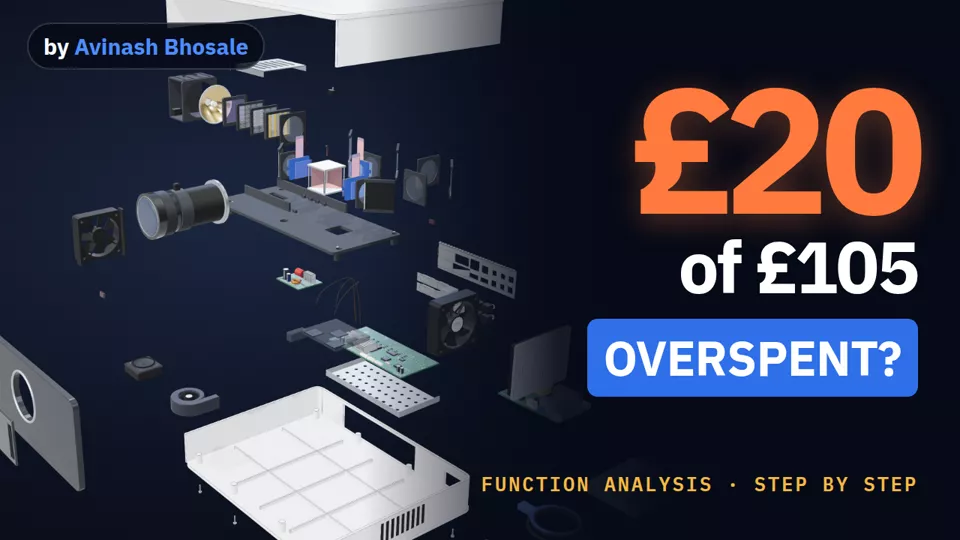 On YouTube · 22 minutesWhere is the £20? The whole of function analysis in one video
All five films below, joined into one, with two challenges to test yourself along the way. Free to watch.
Watch on YouTube (opens in a new tab)
On YouTube · 22 minutesWhere is the £20? The whole of function analysis in one video
All five films below, joined into one, with two challenges to test yourself along the way. Free to watch.
Watch on YouTube (opens in a new tab)
- 1Name the functions
- 2Classify them
- 3Build the FAST diagram
- 4Cost the functions
- 5Find where the cost sits
- 6Set the worth
- 7Pick the targets
Read the transcript
This is the first of five short films on function analysis, the heart of value engineering. By the end of them, you'll be able to do it yourself, step by step, on a real product.
This is the product: a three LCD classroom projector, built to throw a bright picture across a classroom.
Now take it apart.
Fifty kinds of part, in six groups: the light source, the optics, cooling, power, electronics and the housing. Each has a job, and each has a cost.
The usual way to cut cost is to squeeze each supplier, part by part. Function analysis asks a different question. A school doesn't want a lamp, three LCD panels and a lens. It wants a bright, clear picture on the wall. Every part is there only to do a job, and that job is called a function.
The idea came from General Electric in the nineteen-forties. Wartime shortages forced its engineers to use substitute materials, and often the substitute did the job just as well, for less. Lawrence Miles turned that into a method. Don't ask what the part is. Ask what it does, then find the cheapest reliable way to do that.
That gives us value: the function you get, divided by what it costs. We can raise value by doing the same job for less, or by doing more for the same money. What we never do is cut cost by cutting a function the customer needs.
Why go to this trouble? Because it frees the team from today's design. It shows what each job really costs, however many parts it takes. It shows money spent on jobs nobody asked for. And it points the creative session at the right targets.
We'll do it in seven steps. Name the functions, and classify them. Build the FAST diagram. Cost the functions, and find where the cost sits. Set the worth. And pick the targets. Each step has a purpose, and we'll say what it is as we go.
Let's try the question on one part. The lamp burner. What is it? A two hundred and ten watt lamp. What does it do? It generates light. Two words: a verb, and a noun you can measure. That's a function.
On this projector, function analysis turned fifty kinds of part into thirty-two costed functions, and found about twenty pounds a projector spent above what those functions are worth.
So: a function is what a part does, written as an active verb and a measurable noun. Value is function divided by cost. In film two, we name and classify every function in the projector.
2.1Name the functions
Why this step: you can't improve what you can't describe. Naming each job in two words makes the team agree what every part is for, and frees them from how it's done today.
Read the transcript
Film two: naming and classifying functions. Step two point one is to name every function. The purpose: the whole team agrees what every part is for, in words that don't depend on today's design.
There are four rules. Use an active verb and a measurable noun: generate light, in lumens; remove heat, in watts. Say what it does, not how it does it. Avoid weak verbs, such as provide, allow and ensure. And name the job, not the part: trap dust, not filter.
Here are some weak names, and better ones. Provide light tells you nothing you can measure; generate light can be measured in lumens. Protect user is a wish. Interrupt power is a job a switch really does, and you can test it.
Your turn. The fold mirror bends the light through ninety degrees. What is its function? Pause the film and try.
Redirect light. Not reflect light: reflecting is only how a mirror does it. A prism could redirect light too. A good function stays true even if the part is replaced by something completely different.
Now every part, group by group. The light source. The burner generates light, the reflector collects it, and the cage positions the lamp. The safety glass contains fragments if the lamp bursts. The door exposes the lamp, and the baffle deflects heat.
The optics. The fly's-eye arrays divide and distribute the light. The converter polarises it. Dichroic mirrors separate wavelengths into red, green and blue. The LCD panels modulate light, the X-cube combines the three images, and the lens magnifies the image.
Cooling and power. Three fans move air, the filter traps dust, and thermistors sense temperature. The power supply converts voltage. The ballast ignites the arc, then regulates power to the lamp.
Electronics and housing. The main board processes the signal, and the rear connectors receive it. The buttons accept commands. The case encloses components, the shutter interrupts the image, and thirty-eight screws fasten components.
Part functions are detailed. When we draw the product's diagram, related ones roll up. The two fly's-eye arrays and the superposition lens divide, distribute and superimpose light. Together they homogenise light: an even patch of light on every panel.
Step two point two is to classify them. The purpose: to separate the job the customer pays for from everything else. The basic function is the reason the product exists: project image. Secondary functions are needed for the way it's designed. Unwanted functions are side effects nobody asked for. And esteem functions make people want it, rather than making it work.
Unwanted functions need special attention. Nobody asked for heat, ultraviolet, interference, fan noise or a four hundred pound electricity bill. They're worth nothing to the school, yet each one costs money to deal with, as we'll see.
So: name every function as an active verb and a measurable noun, and say what it does, not how. Then classify it. In film three, we arrange them into a FAST diagram.
The rules
- An active verb and a measurable noun. Generate light (lumens), Remove heat (watts), Conduct current (amps).
- Say what it does, not how. The reflector's job is to collect light; reflecting is only how it does it.
- Avoid weak verbs such as provide, allow, enable, permit and ensure. They hide the real job.
- Avoid nouns you can't measure, such as user, buyer or quality.
- Name the job, not the part. Trap dust, not "filter".
Wrong and right
| Part | Weak | Better |
|---|---|---|
| Lamp | Provide light | Generate light |
| Lamp door | Allow access | Expose lamp |
| Interlock switch | Protect user | Interrupt power |
| Front bezel | Look nice | Enhance appearance |
| Air filter | Filter | Trap dust |
| Tilt foot | Level image | Adjust angle |
| Carton | Protect product | Absorb shock |
Common mistake: describing the part or the way it works. A good function would still be true if the part were replaced by something completely different.
2.2Classify them
Why this step: it separates the job the customer pays for from the jobs that only support it, protect it or clean up after it. That's where unnecessary cost usually hides.
The reason the product exists. One per product: Project image.
Needed to deliver the basic function the way it's designed: Generate light, Remove heat.
A side effect nobody asked for: Generate heat, Emit UV, Generate interference, Generate noise, Consume energy. Worth £0.
Makes the product appealing rather than making it work: Enhance appearance. Use functions make it work; esteem functions make people want it.
Common mistake: treating every function as essential. In most products, more of the cost sits in secondary functions than in the basic one.
2.3Build the FAST diagram
Why this step: the FAST diagram (Function Analysis System Technique) turns a list of functions into logic. It shows which functions lie on the path to the customer's need and which hang off it, and it tests the team's understanding of the product.
Read the transcript
Film three: step two point three, the FAST diagram. Its purpose is to turn a list of functions into logic, and to test whether the team really understands the product.
Start with the basic function, the one the customer pays for. For the projector, that's project image.
Ask why we project an image. To communicate information. That's the higher-order function: why the customer wants the product at all. It sits on the left, outside the scope line, because this study won't change it.
Now ask how. How do we project an image? By magnifying it. How do we magnify it? First we need one full-colour image, so we combine images. And how do we get those images? By modulating light, pixel by pixel, in three LCD panels.
How do we modulate light? An LCD panel only works with polarised light, so we polarise it. And before that, we generate light.
How do we generate light? We regulate power to the lamp. How? By converting voltage. And for that, we receive power. The building's supply is outside the study, so it sits past the right-hand scope line. Everything between the scope lines is the critical path.
Now test it backwards, asking why. Why receive power? To convert voltage. Why regulate power? To generate light. Why combine images? To magnify one image. Why magnify it? To project it. If every step makes sense both ways, the logic holds. If not, a card is in the wrong place.
Some functions need more than one answer to how. To modulate light, the panels also need the light split into red, green and blue, and spread evenly. So we separate wavelengths, and homogenise light. Stacked like this, they read as AND: all three are needed. Focus image is a second answer to how we project it.
Below the path go functions that happen at the same time. When we modulate light, we process the signal, and for that we must receive it. When we generate light, the ballast first ignites the arc, with a pulse of about three and a half thousand volts.
Now the unwanted functions, in red. Generating light also generates heat and ultraviolet. Processing the signal generates interference. And receiving power means consuming energy: about four hundred pounds of electricity over five years.
Each unwanted function drags in more. Heat must be removed, so we add fans. The fans pull in dust, so we trap dust, and they generate noise. The ultraviolet must be blocked, and the interference suppressed. None of this is what the school pays for. It exists only because of something unwanted.
Above the path go functions needed all the time, whatever the projector is doing: enclose and locate components, support weight, fasten components, and contain fragments if the lamp ever bursts. Enhance appearance is an esteem function.
Next, user functions, such as accept commands and interrupt image. Then one-time functions, which happen once or only now and then: adjust angle, convey instructions, absorb shock in transit, and expose lamp when it's changed, with interrupt power at the same moment, for safety.
Last, the design criteria. Brightness, resolution, lamp life, noise, safety and price aren't functions. They're requirements that every idea must still meet. Beside them sits the objective: at least ten per cent off the landed cost.
So: start with the basic function and ask how, to build the critical path. Test it with why. Add the scope lines, the AND functions, and the when functions. And mark the unwanted ones, because they drag in cost. In film four, we put a price on every box.
How to read it
- Higher-order function (left, outside scope): why the customer wants the product. Communicate information.
- Basic function (first inside scope): Project image.
- Critical path: each step to the right answers how?, each step to the left answers why?
- Scope lines mark what the study covers. Supply power, from the building's mains, is the input outside scope.
- AND: two or more boxes stacked under one function are all needed together. Modulate light needs Polarise light and Separate wavelengths and Homogenise light.
- Below the path: functions that happen when a path function happens, or are caused by it. Unwanted ones are in red.
- Above the path: functions needed all the time, one-time functions, user functions and esteem.
- Design criteria (dashed box) are requirements such as brightness, noise and safety, not functions. The objective sits beside them so nobody forgets what the study is for.
How the team built it
- Write every function on a card.
- Find the basic function: the one the customer pays for.
- Ask "how?" again and again to build the critical path to the right.
- Check it backwards with "why?". If a step doesn't make sense both ways, a card is in the wrong place.
- Draw the scope lines.
- Place the "when" and "caused by" functions below, including the unwanted ones.
- Place the all-time, one-time, user and esteem functions above.
- Add the design criteria, then test the whole diagram out loud.
Try it: how do we project an image? By magnifying it. How do we magnify it? We need one full-colour image, so we combine images. Now read it back: why combine images? So we can magnify one image. Why magnify it? To project it.
The VH-3600 FAST diagram
Click a box to see its parts in 3D. Switch on the costs to see where the money goes.
Common mistake: laying the cards out in the order the parts sit in the product rather than in how–why order, or letting the diagram grow past the scope.
2.4Cost the functions
Why this step: a part can do several jobs, and a job can need several parts. Sharing each part's cost out among its functions shows what every job really costs. A parts list never can.
Read the transcript
Film four: steps two point four and two point five. Costing the functions, and finding where the cost sits.
Why cost functions, when we already know what the parts cost? Because a part can do several jobs, and a job can need several parts. A parts list can never show what a job really costs.
So each part's cost is shared out among its functions, based on what's inside it. The main board's video chip, drivers and memory process the signal: thirteen pounds. Its network chip receives the signal, and its amplifier drives the speaker. The ballast ignites the arc and regulates power. The power supply's filter suppresses interference. The shares always add back to the part's cost.
Do that for every part and you get the function cost matrix: fifty parts against thirty-two functions. Each row adds up to its part. Each column gives a function's cost. And the grand total must still be a hundred and five pounds twenty, or something's been lost.
Now put those costs on the FAST diagram. The colours show value, which we'll come to in film five. For now, just look at where the money sits.
Group the costs by where they sit. Fifty-seven per cent of the parts cost is on the critical path, doing the job the school pays for. The other forty-three per cent supports it, protects it, or cleans up after something unwanted.
Follow the red boxes. Removing heat, trapping dust, blocking ultraviolet and suppressing interference cost five pounds eighty-nine a projector. That's money spent only because of unwanted functions. Make less heat, or stop the interference at its source, and some of it disappears.
So, of a hundred and five pounds twenty: fifty-nine pounds fifty-four does the job itself. Thirty-nine seventy-seven supports it. And five eighty-nine exists only because of unwanted functions. That last pile is often the easiest money in the whole study.
Step two point five: rank the functions by cost, largest first, and add a running total. This is a Pareto chart. Its purpose is to show where effort will pay back. Thirty per cent of the functions, ten out of thirty-two, carry seventy-eight per cent of the cost.
These ten are where to look first: modulate light, process signal, generate light, magnify image, combine images, convert voltage, receive signal, remove heat, regulate power and enclose components. The other twenty-two share just twenty-three pounds between them.
So: share each part's cost among its functions, check it adds up, put the costs on the FAST diagram, and rank them. Cost tells us where the money goes. It doesn't tell us whether it's good value. That's worth, in film five.
Each share is estimated from what the part contains. The main board's video chip, panel drivers and memory process the signal (£13.00); its network interface receives it (£0.55); its amplifier drives the speaker (£0.45). The shares always add back up to the part's cost.
Cost basis: the parts cost of one projector, £105.20, at 200,000 a year. Assembly, overheads and freight aren't shared out over functions; they're handled with the factory ideas in phase 3.
Where the cost goes on the FAST diagram
Common mistake: putting a part's whole cost on its main function. The main board would then hide what receiving the signal and sound really cost.
2.5Find where the cost sits
Why this step: a few functions carry most of the cost. Ranking them shows where effort will pay back, and stops the team spending days on functions worth pennies.
Function costs, largest first
2.6Set the worth
Why this step: cost tells you what you pay. Worth tells you what you should pay: the lowest cost shown to perform the function reliably. The difference is the prize.
Read the transcript
Film five: steps two point six and two point seven. Setting the worth, and picking the targets.
Worth is the lowest cost shown to perform the function reliably. Cost is what you pay. Worth is what you should pay. The difference is the prize. And every worth needs evidence: it's never a guess.
There are five common ways to set it. A cheaper way that does the same job to the same standard. A supplier quote, or a should-cost. A benchmark, but only one that meets every must-be need. What the customer actually needs: one VGA input, not three. And the theoretical minimum. An unwanted function is worth nothing at all.
Be careful with benchmarks. A single-chip DLP projector is cheaper, but it gives about fourteen hundred colour lumens, not thirty-six hundred. It fails a must-be need, so it can't set the worth of modulating light.
Cost and worth give two numbers. The value gap, cost minus worth, is the money at stake. The value index, cost divided by worth, shows how far off fair value it is. One point two five or more is worth a look; two or more is a strong target. Use both: a high index on a few pence matters less than a modest one on many pounds.
Here's why it matters. Modulating light is the biggest cost in the projector, but it's good value: an index of one point oh four. Receiving the signal costs five pounds, for a job worth one pound thirty. Its index is three point eight five: ports and a cable that few schools ever use.
Sort by value gap and two functions stand out. Process signal has the biggest gap, four pounds twenty-five. Receive signal is next, at three pounds seventy, with the worst index. Locate components has an index of two: a steel cage doing a job the case could do.
Worth asks: what's the cheapest way to do this? The team also asks: how much does the school care? In a paired comparison, they take the ten functions a school would notice and compare every pair. Which matters more to a teacher: generating light, or receiving the signal? The winner scores one, two or three points. It's the team's judgement, from the school interviews, and it isn't perfectly consistent. That's normal.
Then set each function's share of the importance against its share of the cost. Process signal takes seventeen per cent of the cost for five per cent of the importance. Combine images and enclose components are flagged too. But combine images has no cheaper way to do it, so it stays. Use the graph to find questions. Use worth to answer them.
Step two point seven: pick the targets. Read the costed FAST diagram for clues, and turn each one into a question. Does the school need all of receive signal? Can fewer parts process the signal? Can we make less heat? Can we stop the interference at its source? Can two functions share one board?
These are the targets: functions with a big gap, a high index, or a cost driven by something unwanted. Not simply the most expensive ones. Modulate light, the biggest cost of all, is left alone, apart from a cheaper material in one corner.
For every target, the creative session asks one question. How else could we perform this function, at the lowest total cost, with no loss of performance, quality, reliability or safety?
That's function analysis: name, classify, build the FAST diagram, cost it, rank it, set the worth, and pick the targets. In this study, those targets led to twenty-four ideas, and seventeen per cent off the landed cost. Next, the creative phase.
Five ways to set worth
- A cheaper alternative that does the same job to the same standard: organic polarisers where it runs cooler.
- A supplier quote or should-cost: local optical glass.
- A benchmark, but only if it meets every must-be need. DLP is cheaper, but fails on colour brightness, so it can't set a worth.
- What the customer needs: if only part of a function is used, only that part has worth (one VGA input, not three).
- The theoretical minimum: unwanted functions are worth £0; a one-time job is worth the least that does it once.
Two numbers from cost and worth
- Value gap = cost − worth. The money at stake.
- Value index = cost ÷ worth. 1.0 is fair value. Above about 1.25 is worth a look; 2 or more is a strong target, a common rule of thumb.
- Use both. A high index on a few pence matters less than a modest index on many pounds.
What the school values: a paired comparison
Worth asks "what's the cheapest way to do this?". The team also asks "how much does the school care?". Each pair of functions the school can see is compared, and the winner gets 1, 2 or 3 points. This is the study team's judgement, made on the school's behalf from the interviews in phase 1, and it isn't perfectly consistent: three of the low-scoring functions beat each other in a circle, which happens in real workshops.
Importance against cost: the value graph
Where a function's share of the cost is far bigger than its importance, look harder. Process signal and Enclose components are flagged here and confirmed by the worth evidence. Combine images is flagged too, but customers can't see what it does and there's no cheaper way to do it, so it stays. Modulate light costs more than its share of importance, but nothing cheaper meets the must-be needs. Use the graph to find questions; use worth to answer them.
Common mistake: setting worth from a benchmark that doesn't meet the must-be needs, or from an idea nobody has checked.
2.7Pick the targets
Why this step: the costed FAST diagram is full of clues. Each one becomes a question for the creative session: how can we perform the same function, at the lowest total cost, with no loss of performance, quality, reliability or safety?
| Clue | Question for the creative session | Led to |
|---|---|---|
| Receive signal has the highest value index on real money (3.85) | Does the school need all of it? | V01, V10, V13 |
| Process signal has the biggest value gap (£4.25) | Can fewer or simpler parts do it? | V02, V13, V17, V18 |
| The unwanted Generate heat drives Remove heat and Trap dust (£4.34) | Can we make less heat, or remove it with less? | V08, H1 |
| The unwanted Generate interference drives £1.25 of filtering and shielding | Can we stop it at the source? | V16 |
| Convert voltage and Regulate power sit on two separate boards | Can two functions share parts? | V03 |
| Enclose, Locate and Fasten components use the case, a steel cage and 38 screws | Can the case do the bracket's and the screws' job? | V07, V09, V14 |
| Modulate light is the biggest cost, but good value (1.04) | Leave the design; can a cheaper material do part of it? | V05 |
| One-time functions: Absorb shock, Convey instructions | What's the least that does it once? | V10, V19 |
- Every part has a verb-noun function
- The FAST diagram passes the how–why test
- Function costs add up to the bill of materials
- Every worth has evidence, and the targets are agreed
3Phase 3 · Creative
Lots of ideas, no judging yet
The team works on the target functions only, using brainstorming, SCAMPER, TRIZ, design for manufacture and assembly, the teardown and ideas from suppliers. The rule is simple: no idea is criticised during the session. Twenty-four ideas come out: the report's twenty (V01–V20) and four more (H1–H4). Each one is tied to the functions and parts it changes; press 3D to see them in the model. A quick screen afterwards drops anything that breaks a must-be need, and parks anything that's really a different product.
Read the transcript
Step three is the creative phase. Lots of ideas, and no judging yet.
The team works on the target functions only, using brainstorming, SCAMPER, TRIZ, design for assembly, teardowns, and ideas from suppliers.
Drop the legacy ports that few schools use, and keep HDMI, one VGA, network and USB. Three pounds eighty a projector.
Put the power supply and the lamp ballast on one board, sharing one filter and one heatsink. Two pounds ten.
Redesign the airflow so two fans do the work of three. One pound ten.
Some ideas don't touch the product at all. Faster curing on the alignment rig, and a shorter burn-in, save one pound seventy-five between them.
Twenty-four ideas in all, each one tied to the parts and the functions it changes.
Then a quick screen. It drops only what breaks a must-be. Single-chip DLP is cheaper, but it can't give a bright colour picture, so it's out.
- Ideas for every target function
- Nothing judged during the session
- Only must-be failures dropped at screening, with the reason written down
4Phase 4 · Evaluation
Score every idea the same way
Before anyone scores an idea, the team and the sponsor agree the criteria and their weights: saving 30%, risk 25%, what the customer gets 20%, one-off cost 15% and speed 10%. Each idea is then scored from 1 to 5 against each one, where 5 is always good: a big saving, a low risk, a small investment. Agreeing the weights first stops people working back from the answer they want. Eighteen ideas are a clear go; three need a feasibility check first.
Read the transcript
Step four is evaluation. Every idea is scored in the same way.
First, the team and the sponsor agree the criteria and their weights. Saving, thirty per cent. Risk, twenty-five. What the customer gets, twenty. One-off cost, fifteen. And speed, ten.
Then each idea is scored from one to five against each criterion, where five is always good. Dropping the VGA cable comes top: a real saving, almost no risk, and quick to do.
Eighteen ideas are a clear go. Three, like the plastic lens elements, need a feasibility check first.
Agreeing the weights before scoring stops anyone working back from the answer they wanted.
- Criteria and weights agreed before scoring
- Every score has a reason
- Shortlist agreed by the sponsor
5Phase 5 · Development
Turn the best ideas into business cases
A good idea isn't a saving yet. Each idea on the shortlist gets numbers finance will sign: the saving per projector, the one-off cost, the payback, the risks and the tests needed before it goes into production. Three are shown in full here: the biggest saving, the riskiest and the quickest. Then all twenty, grouped into the report's four waves.
Read the transcript
Step five is development. A good idea isn't a saving until it has a business case.
Dropping the legacy ports saves three pounds eighty a projector. That's seven hundred and sixty thousand pounds a year, for a one-off cost of thirty-five thousand.
The risk is the schools that still use those ports. Room control can move to the network port, and sales check the installed base before launch.
One board for power and ballast saves two pounds ten, but it needs the most care. The lamp's three and a half thousand volt ignition pulse sits next to low-voltage parts.
All twenty ideas go into four waves, from quick wins in three months to longer engineering over fourteen.
The big questions are tested too. DLP would land nine pounds sixty-five cheaper, but with about fourteen hundred colour lumens, not thirty-six hundred.
And a laser light source adds thirteen pounds fifty. That makes it a decision for a premium model, not a cost saving.
Why not switch to DLP?
The team tested the biggest idea of all (H3) against the report's benchmark. DLP is cheaper to build, but it gives about 1,400 colour lumens against 3,600. In a lit classroom that's a must-be failure, so it was rejected.
Lamp or laser?
For the maker, a laser-phosphor engine (H2) costs £27.60 against £14.10 for the lamp and ballast: £13.50 more a projector. It removes lamp changes and lamp warranty claims, and supports a retail premium of £90 or more, so it belongs on a premium model. For the school, it depends on how hard the projector works:
- Savings and one-off costs signed off by finance
- Every risk has an owner and a test
- Suppliers have confirmed prices in writing
6Phase 6 · Presentation
Ask for a decision, then track the savings
The study ends with a short meeting and a clear ask, not a long report. The sponsor sees the result, the money, the risks and the plan, and decides. After that, savings are tracked every month against the old cost until they're banked.
Read the transcript
Step six is presentation. A short meeting, a clear ask, and a decision.
From a landed cost of a hundred and forty-two pounds seventy, the ports and the board take off five twenty-five. Power, two ten. Optics, four ten. The case and fans, three thirty. Packing and the factory, three sixty.
The core twelve ideas reach a hundred and twenty-four thirty-five, past the ten per cent target. All twenty reach a hundred and eighteen pounds five.
That's seventeen per cent off the cost: four point nine million pounds a year, paying back in under two months.
The ask is simple. Approve waves one and two now. Fund the engineering for three and four. Ship in eco mode. And take laser to the product plan.
Then the real work starts. Engineer it, test it, release it, and track every saving monthly until finance sees it in the actual cost.
From today's cost to the target
The plan: 14 months, four waves
The savings funnel
After the workshop
- Engineer and test each approved idea, with the tests from its business case.
- Release it through a formal engineering change, with a date it starts in the factory.
- Bank it only when finance sees the lower cost in the actual price paid or the factory's invoice.
- Review monthly: savings banked, ideas late, risks that came true. Most savings are lost between approval and the factory, which is why this matters.
✓What we learnt
Eight lessons from one projector
Read the transcript
So what did one projector teach us?
Check the facts: even a good report had five things that didn't add up. Think in functions: the most expensive job was good value, and the worst value hid in a cheap one. And let the customer set the worth. One fact, that over ninety per cent of classrooms use HDMI, is behind six pounds thirty of savings.
Value isn't only in the design: four pounds of savings came from the factory and the supply chain. Agree the criteria before you score. And remember, value depends on who pays. Eco mode costs the maker nothing, and saves the school a quarter of its power.
Twenty-four ideas, seventeen per cent, one method. Now try it on a product of your own.
A detailed report still had five things that didn't add up. Finding them before the workshop kept every later number honest.
Module 3 · InformationThe most expensive function, modulating light, was good value. The worst value hid in a cheap one: receiving the signal through ports few schools use.
Module 4 · Function analysisOver 90% of classrooms use HDMI. That one fact is behind £6.30 of savings: the ports, the smaller board and the cable.
Module 3 · Information£4.05 a projector came from the factory and supply chain (faster curing, shorter burn-in, better stock) with no change to the product.
Module 9 · Should-costingTwenty-four ideas came from keeping the two apart. Three were screened out, each with a written reason.
Module 5 · CreativeWeighted scoring made the choice visible and fair, and it flagged the three ideas that need proving before anyone spends on them.
Module 6 · EvaluationBusiness cases, tests, owners, waves and monthly tracking turn £24.65 of ideas into money in the bank.
Module 8 · PresentationEco mode costs the maker nothing and saves the school a quarter of its power. Laser costs the maker more but can suit a busy lecture theatre.
Module 1 · Foundations